The National Institute of Standards and Technology (NIST) AI Risk Management Framework (NIST AI 100-1) is a voluntary, non-sector-specific, and use-case agnostic operational framework developed under the direction of the National Artificial Intelligence Initiative Act of 2020 (P.L. 116-283). It equips small and medium-sized enterprises (SMEs) to identify, govern, measure, and treat risks across the full artificial intelligence lifecycle.
What It Is
The NIST AI RMF 1.0 serves as a standardised operational guide for organisations that design, develop, acquire, deploy, or operate AI systems. AI systems introduce socio-technical risks distinct from traditional software, including non-deterministic outputs, complex supply chains, training-data drift, and unpredictable downstream societal impacts. The framework establishes consensus definitions, testing methodologies, and organisational practices to operationalise trustworthy AI across commercial and technical workflows.
What It Does
The framework translates abstract risk principles into measurable technical and organisational controls. Specifically, it enables enterprise stakeholders to:
- Determine organisational risk tolerance and execute defensible go/no-go deployment decisions.
- Map dependencies across the AI value chain, including pre-trained models, fine-tuning data, third-party software, and cloud application programming interfaces (APIs).
- Deploy Test, Evaluation, Verification, and Validation (TEVV) protocols to baseline and track system performance.
- Address trade-offs between competing system characteristics, such as the tension between predictive accuracy, model interpretability, and privacy preservation.
- Mitigate negative impacts across three distinct operational domains: harms to individuals and communities, harms to enterprise operations and business continuity, and harms to external ecosystems or supply chains.
Key Characteristics of Trustworthy AI
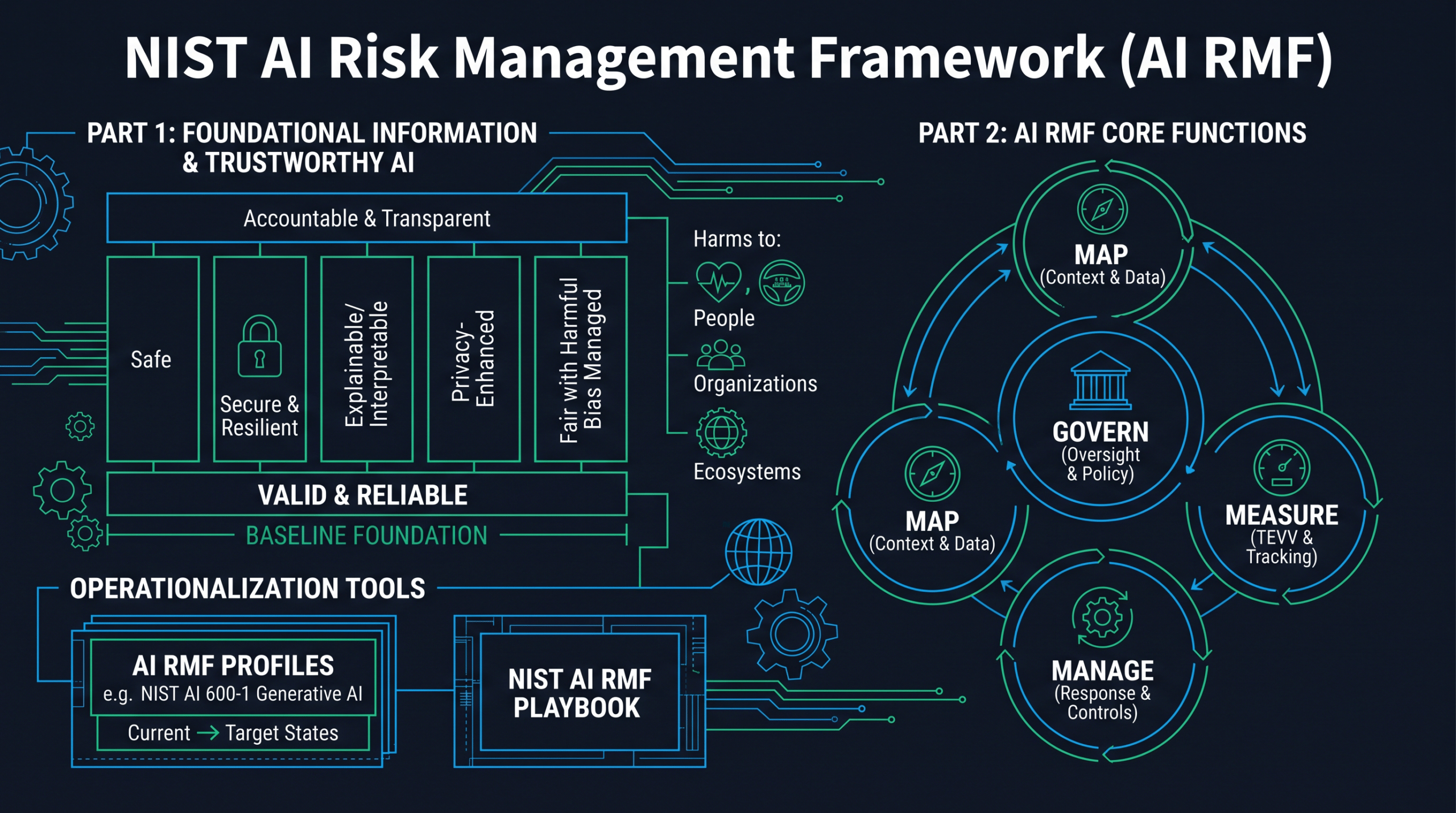
The framework defines seven interrelated technical and governance characteristics necessary for trustworthy AI systems:
- Valid and Reliable: The baseline requirement ensuring the system operates correctly within intended parameters and fulfils specified operational requirements under expected conditions.
- Safe: The prevention of operational states that lead to physical, psychological, or economic injury or endanger human life.
- Secure and Resilient: The ability of the system to maintain confidentiality, integrity, and availability, withstand adversarial manipulation (such as data poisoning or evasion attacks), and degrade gracefully under failure conditions.
- Accountable and Transparent: The systemic maintenance of auditable design logs, dataset documentation, and clear user disclosures regarding the presence of AI-generated content.
- Explainable and Interpretable: The provision of contextual technical descriptions regarding how the model functions and why specific outputs or recommendations were produced.
- Privacy-Enhanced: The enforcement of strict data governance safeguards, data minimisation, and technical protections preventing unauthorised extraction of personally identifiable information (PII).
- Fair with Harmful Bias Managed: The identification and mitigation of demographic skew, algorithmic disparities, and systemic prejudice within training data, algorithmic weights, and operational usage.
Framework Structure
The NIST AI RMF is organised into two primary parts: Foundational Information and the Core.
Part 1: Foundational Information
Establishes risk framing, delineates how AI risks diverge from legacy IT systems, defines the trustworthy characteristics, and outlines organisational responsibilities across AI actor tasks.
Part 2: The AI RMF Core
The Core provides outcomes organised into four continuous, non-linear functions subdivided into categories and actionable subcategories:
| Function | Primary Role | Operational SME Focus |
| GOVERN | Cross-cutting oversight; establishes enterprise policies, legal compliance, risk tolerances, and accountability structures. | Formulate executive AI policies, define go/no-go thresholds, and establish incident reporting procedures. |
| MAP | Context categorisation; documents intended purposes, system boundaries, dependencies, and potential adverse impacts. | Catalog third-party models and data dependencies, identify user personas, and evaluate operational assumptions. |
| MEASURE | Quantitative and qualitative analysis; executes formal TEVV processes, safety metrics, and ongoing monitoring. | Track model drift, measure precision/recall, audit bias, and evaluate vulnerability to prompt injection or model inversion. |
| MANAGE | Resource allocation and treatment; prioritises identified risks and executes mitigation, override, and decommissioning plans. | Deploy access controls, implement human-in-the-loop overrides, monitor third-party API dependencies, and conduct root-cause audits. |
Implementation Resources: Profiles and the Playbook
To operationalise the Core without excessive administrative burden, organisations utilise two companion tools:
- AI RMF Profiles: Practical blueprints that adapt Core functions to specific industry sectors, organisational tiers, or technology domains. Profiles enable organisations to map their “Current Profile” (present risk posture) against a “Target Profile” (desired compliance state), identifying actionable gaps for targeted resource allocation. A key implementation is the Generative AI Profile (NIST AI 600-1), which outlines targeted controls for large language models, confabulations, and synthetic content generation.
- NIST AI RMF Playbook: An online, living repository of tactical implementation actions, technical checklists, and suggested documentation references aligned to each Core subcategory.
Enterprise Compliance and Security Integration
For small and medium-sized enterprises, the NIST AI RMF functions as a bridge connecting commercial AI adoption to enterprise cybersecurity, privacy compliance, and third-party assurance:
- Regulatory Mapping: Provides technical scaffolding to satisfy third-party audit requirements under ISO/IEC 42001 (Artificial Intelligence Management System) and risk-assessment obligations under the EU AI Act (Articles 11, 12, and 50).
- Security Operations Handoff: Integrates AI threat vectors—such as adversarial prompt injection, API token leakage, and insecure data retrieval pipelines—directly into the security team’s central Risk Register and Security Information and Event Management (SIEM) systems.
- Audit Artefacts: Produces defensible documentation, including Model Cards, context-mapping inventories, red-team evaluation reports, and third-party vendor review assessments.