1. What ISO/IEC 42001 Is
ISO/IEC 42001:2023 is the international management system standard (MSS) for establishing, implementing, maintaining, and continually improving an Artificial Intelligence Management System (AIMS). Published jointly by the International Organisation for Standardisation (ISO) and the International Electrotechnical Commission (IEC) in December 2023, it serves as the baseline certifiable benchmark for organisational AI governance.
The standard applies to any entity—regardless of size, sector, or maturity—that develops, provides, integrates, or uses products or services that utilise AI systems. Rather than evaluating static model parameters or isolated algorithmic weights, ISO/IEC 42001 assesses the overarching organisational management processes, systemic risk controls, and governance structures that dictate how AI systems are engineered, procured, and monitored across their complete lifecycle.
2. What ISO/IEC 42001 Does
ISO/IEC 42001 provides a structured, risk-based operational framework that balances algorithmic innovation with defensible accountability, transparency, and safety. Specifically, the standard:
- Establishes Governance and Accountability: Mandates clear top-management oversight, formal organisational policies, defined AI roles, and distinct escalation pathways for algorithmic anomalies and ethical concerns.
- Enforces Continuous AI Risk Management: Requires organisations to establish structured processes to identify, assess, prioritise, and treat risks unique to AI, such as autonomous drift, non-explainability, systemic bias, data poisoning, and unauthorised automated decisions.
- Mandates AI System Impact Analyses: Forces organisations to analyse consequences not only on internal operations, but specifically on individuals, vulnerable user groups, fundamental human rights, and society.
- Operationalises Data Governance: Embeds strict controls across data acquisition, data quality, data preparation, and full data provenance to prevent degraded inferences, contamination, or unauthorised personal data processing.
- Governs Third-Party AI and Supply Chain Dependencies: Establishes accountability boundaries between upstream foundational model providers, third-party software integrators, and downstream enterprise deployers.
- Enables Third-Party Auditability and Certification: Provides objective criteria and auditable artifacts—such as the Statement of Applicability (SoA) and continuous logging records—allowing independent conformity assessment bodies to certify the organization’s AI posture.
- Facilitates Statutory Compliance: Provides an operational architecture that directly aligns with global statutory mandates, serving as a primary technical mechanism to demonstrate conformity with the EU AI Act (Regulation (EU) 2024/1689), GDPR accountability mandates, and the NIST AI Risk Management Framework (AI RMF 1.0).
3. Architecture and Structure of the Standard
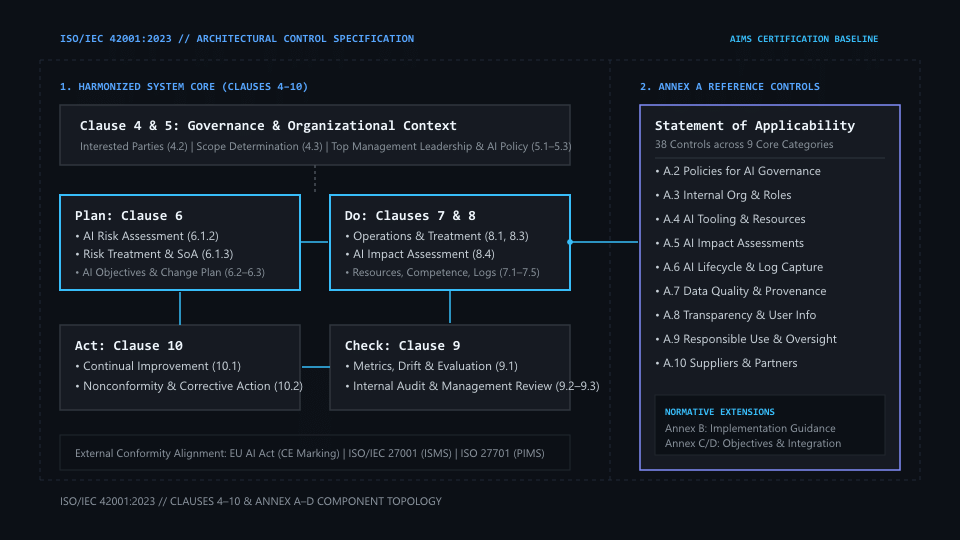
ISO/IEC 42001 adopts the ISO Harmonised Structure (formerly High-Level Structure / HLS). This standardised format utilises identical clause sequences, titles, core text, and baseline definitions shared across other management standards such as ISO/IEC 27001 (Information Security) and ISO 9001 (Quality Management).
The document is divided into two primary structural operational blocks:
- Management Clauses (Clauses 4 through 10): The core normative requirements specifying the policies, processes, resources, and leadership structures necessary to run the management system. Conformity to all requirements in Clauses 4 to 10 is mandatory for certification.
- Annexes (Annex A, B, C, and D): Operational controls, implementation technical guidance, risk sources, and multi-domain integration patterns.
4. Summary of Management Clauses (Clauses 4–10)
Clause 4: Context of the Organisation
- 4.1 Understanding the organisation and its context: Requires determination of external and internal issues affecting the AI management system, explicitly factoring in technological complexity, legal boundaries, and environmental considerations such as climate change.
- 4.2 Understanding the needs and expectations of interested parties: Mandates identification of relevant stakeholders (regulators, consumers, affected individuals, enterprise partners) and determination of their legal, contractual, and societal requirements.
- 4.3 Determining the scope of the AI management system: Defines the operational and physical boundaries of the AIMS, including whether the organisation functions as an AI developer, deployer, system integrator, or downstream consumer.
- 4.4 AI management system: Requires the establishment, implementation, documentation, and continuous maintenance of the AIMS processes and their interactions.
Clause 5: Leadership
- 5.1 Leadership and commitment: Top management must actively integrate AIMS requirements into core business workflows, ensure adequate tooling and human resource allocation, and promote accountability.
- 5.2 AI policy: Requires top management to define, approve, and communicate a formal AI policy aligned with corporate strategy, ethical commitments, and regulatory requirements.
- 5.3 Organisational roles, responsibilities, and authorities: Mandates assigning explicit responsibilities for AIMS conformity and technical performance reporting to executive leadership.
Clause 6: Planning
- 6.1 Actions to address risks and opportunities: Establishes the risk framework to prevent undesired effects and achieve intended AI performance.
- 6.1.2 AI risk assessment: Mandates reproducible, documented risk assessment processes that evaluate probability and consequence severity for the organisation, individuals, and society.
- 6.1.3 AI risk treatment: Defines treatment plans, maps chosen safeguards against Annex A reference controls, and requires a documented Statement of Applicability (SoA) justifying all control inclusions and exclusions.
- 6.2 AI objectives and planning to achieve them: Requires measurable, monitored AI performance objectives across functional operational teams.
- 6.3 Planning of changes: Requires that modifications to models, infrastructure, or operational scope be executed in an auditable, planned sequence.
Clause 7: Support
- 7.1 Resources: Requires identification and provision of necessary resources, including compute hardware, infrastructure, data pipelines, tooling, and specialised personnel.
- 7.2 Competence: Requires validation that personnel designing, training, deploying, or auditing AI possess appropriate training, qualifications, and domain experience.
- 7.3 Awareness: Mandates organisational understanding of the AI policy, individual contributions to AI performance, and the operational risks of nonconformance.
- 7.4 Communication: Establishes internal and external communication protocols regarding AI risks and changes.
- 7.5 Documented information: Enforces standardised record keeping, version control, access controls, and retention for all AIMS operational artifacts.
Clause 8: Operation
- 8.1 Operational planning and control: Enforces operational controls over internal and outsourced AI system workflows.
- 8.2 AI risk assessment: Mandates execution of the Clause 6.1.2 risk assessment methodology at scheduled operational intervals or upon significant system changes.
- 8.3 AI risk treatment: Mandates operational execution and validation of the risk treatment plans and control configurations.
- 8.4 AI system impact assessment: Mandates documented assessments evaluating how specific AI applications affect external end-users, groups, civil rights, and societal safety prior to production releases.
Clause 9: Performance Evaluation
- 9.1 Monitoring, measurement, analysis, and evaluation: Requires telemetry, quantitative metrics, and qualitative methods to evaluate model accuracy, drift, latency, fairness, and overall AIMS efficacy.
- 9.2 Internal audit: Requires independent internal audits at planned intervals to verify whether the AIMS conforms to standard requirements and is effectively maintained.
- 9.3 Management review: Requires executive leadership to formally review AIMS audit results, risk assessments, operational KPIs, and nonconformities to determine strategic updates.
Clause 10: Improvement
- 10.1 Continual improvement: Enforces ongoing upgrades to the suitability, adequacy, and effectiveness of the AIMS.
- 10.2 Nonconformity and corrective action: Requires immediate containment, root-cause investigation, corrective measures, and auditable logging whenever an AI control failure or operational incident occurs.
5. Summary of Annexes (Annexes A–D)
Annex A: Reference Control Objectives and Controls (Normative)
Annex A contains 38 baseline operational controls organised across 9 topical categories. Organisations must benchmark their risk treatments against these controls within their Statement of Applicability.
| Control Category | Focus and Core Requirements |
| A.2 Policies related to AI | Governance policies for AI development, operational alignment with broader enterprise policies (cybersecurity, privacy), and planned policy review cadences. |
| A.3 Internal organization | Definition and allocation of AI responsibilities across engineering, legal, and operational units, including whistleblower/concern-reporting mechanisms. |
| A.4 Resources for AI systems | Inventory, documentation, and capacity planning for data sources, tooling, compute infrastructure (GPUs, cloud nodes), and human expertise. |
| A.5 Assessing impacts of AI systems | Formal processes for assessing, documenting, and mitigating negative impacts on individual legal positions, human rights, and broader societal stability. |
| A.6 AI system life cycle | Technical controls across the software engineering lifecycle: requirements definition, system specifications, verification and validation (V&V), deployment sign-offs, production monitoring, technical documentation, and continuous event logging. |
| A.7 Data for AI systems | Rigorous data management controls covering data acquisition, dataset quality criteria, end-to-end data provenance tracking, and data preparation techniques. |
| A.8 Information for interested parties | User-facing documentation, explainability notices, transparency disclosures, external impact reporting, and automated incident communication paths. |
| A.9 Use of AI systems | Policies and controls governing acceptable deployment, verification of intended use parameters, and human-in-the-loop / human-on-the-loop oversight mechanisms. |
| A.10 Third-party and customer relationships | Apportionment of operational risk and legal accountability between data providers, model suppliers, software vendors, and downstream enterprise clients. |
Annex B: Implementation Guidance for AI Controls (Normative)
Annex B provides detailed, clause-by-clause technical implementation instructions for every Annex A control. It translates high-level requirements into explicit engineering and organisational actions, including guidance on:
- Establishing specific criteria for AI verification and validation.
- Implementing event log capture to enable post-incident forensic evaluation.
- Assessing societal impact vectors, including carbon output, environmental sustainability, economic displacement, and generative misinformation.
- Structuring human oversight models, including override authorizations and fail-safe fallback states.
Annex C: Potential AI-Related Objectives and Risk Sources (Informative)
Annex C outlines strategic organisational objectives and corresponding risk profiles that organisations must address during risk mapping. Core objective dimensions include:
- Fairness, non-bias, and equitable outcomes.
- Accountability, traceability, and governance oversight.
- Explainability and interpretability of model inferences.
- System robustness, fault tolerance, and security resilience.
- Data availability, lineage, and training data quality.
- Privacy preservation and confidential compute guarantees.
- Environmental sustainability and technological maturity.
Annex D: Cross-Domain and Sector-Specific Use (Informative)
Annex D details how ISO/IEC 42001 operates in concert with other management systems and vertical industry standards:
- ISO/IEC 27001 (Information Security): Allows organisations to integrate AI security threats (e.g., model inversion, data poisoning, prompt injection) directly into their centralised Information Security Management System (ISMS).
- ISO/IEC 27701 (Privacy Information Management): Links AI personal data processing, controller/processor definitions, and inference privacy directly with established Privacy Information Management Systems (PIMS).
- ISO 9001 (Quality Management): Integrates AI software lifecycle quality and dataset reliability into overarching enterprise quality assurance programs.
- Vertical Standards: Enables unified compliance audits alongside sector frameworks, such as ISO 13485 / IEC 62304 (Medical Devices) and ISO 22000 (Food Safety).
6. Supporting AI Standards Ecosystem
ISO/IEC 42001 is supported by a family of specialized ISO/IEC standards that expand upon individual technical domains:
- ISO/IEC 22989: Artificial intelligence concepts and terminology.
- ISO/IEC 23894: Guidance on AI risk management for developers, deployers, and users.
- ISO/IEC 38507: Governance implications of the use of AI by organisations.
- ISO/IEC 42005: Guidance on AI system impact assessments.
- ISO/IEC 42006: Requirements for bodies providing audit and certification of AI management systems.
- ISO/IEC 5259 Series: Data quality requirements and evaluation metrics for AI and ML systems.
- ISO/IEC TR 5469: Functional safety considerations and engineering controls for AI systems.