NIST AI 600-1, titled Artificial Intelligence Risk Management Framework: Generative Artificial Intelligence Profile, is a formal guidance document published by the U.S. National Institute of Standards and Technology (NIST) in July 2024 as a companion resource to the foundational NIST AI Risk Management Framework (AI RMF 1.0, NIST AI 100-1). It translates the broad socio-technical risk controls of the AI RMF into actionable, technology-specific engineering and governance requirements for generative artificial intelligence (GAI), foundation models, and agentic deployments.
For small and medium-sized enterprises (SMEs) operating in the European Union, NIST AI 600-1 serves as a practical, auditable blueprint to operationalise technical compliance. It maps technical risks directly to EU regulatory baselines, including the EU AI Act (Regulation (EU) 2024/1689) transparency and General-Purpose AI (GPAI) provisions, the General Data Protection Regulation (GDPR), and critical ICT supply chain obligations under NIS2 and DORA.
What NIST AI 600-1 Is
NIST AI 600-1 is a cross-sectoral technology profile designed to address risks unique to or exacerbated by generative AI. Under its operational scope, GAI encompasses dual-use foundation models, large language models (LLMs), multimodal systems, diffusion models, and autonomous generative agents that produce synthetic text, code, audio, and visual media.
Traditional predictive systems execute discrete, deterministic tasks against fixed datasets. Generative AI systems rely on billions of parameters, open-ended natural-language interfaces, and complex multi-tenant retrieval pipelines. This creates non-deterministic outputs, an expanded cyberattack surface, and severe data-lineage challenges. NIST AI 600-1 identifies these behavioural anomalies and provides targeted actions for organizations acquiring, fine-tuning, or deploying GAI systems.
What NIST AI 600-1 Does
The profile operationalizes risk governance across the entire generative AI lifecycle—from data sourcing and pre-training to fine-tuning, Retrieval-Augmented Generation (RAG), and production deployment. Specifically, the document enables EU SMEs to:
- Establish Baseline Risk Tolerances: Define explicit go/no-go deployment thresholds, acceptable use policies for commercial and open-weight models, and emergency operational kill switches.
- Secure the Generative AI Attack Surface: Identify and mitigate generative-specific cyber threats, including direct and indirect prompt injection, training-data poisoning, model extraction, and insecure API execution.
- Enforce Data Protection and Lineage: Maintain verifiable provenance across training data, user inputs, and generated synthetic media, ensuring compliance with data minimization and purpose limitation.
- Evaluate Model Accuracy and Trustworthiness: Implement continuous Test, Evaluation, Verification, and Validation (TEVV) workflows, utilizing automated red-teaming, benchmark evaluations, and empirical drift detection.
- Govern Upstream ICT Dependencies: Manage counterparty risk, vendor lock-in, and extraterritorial data-transfer exposure when integrating third-party commercial APIs and foundation models.
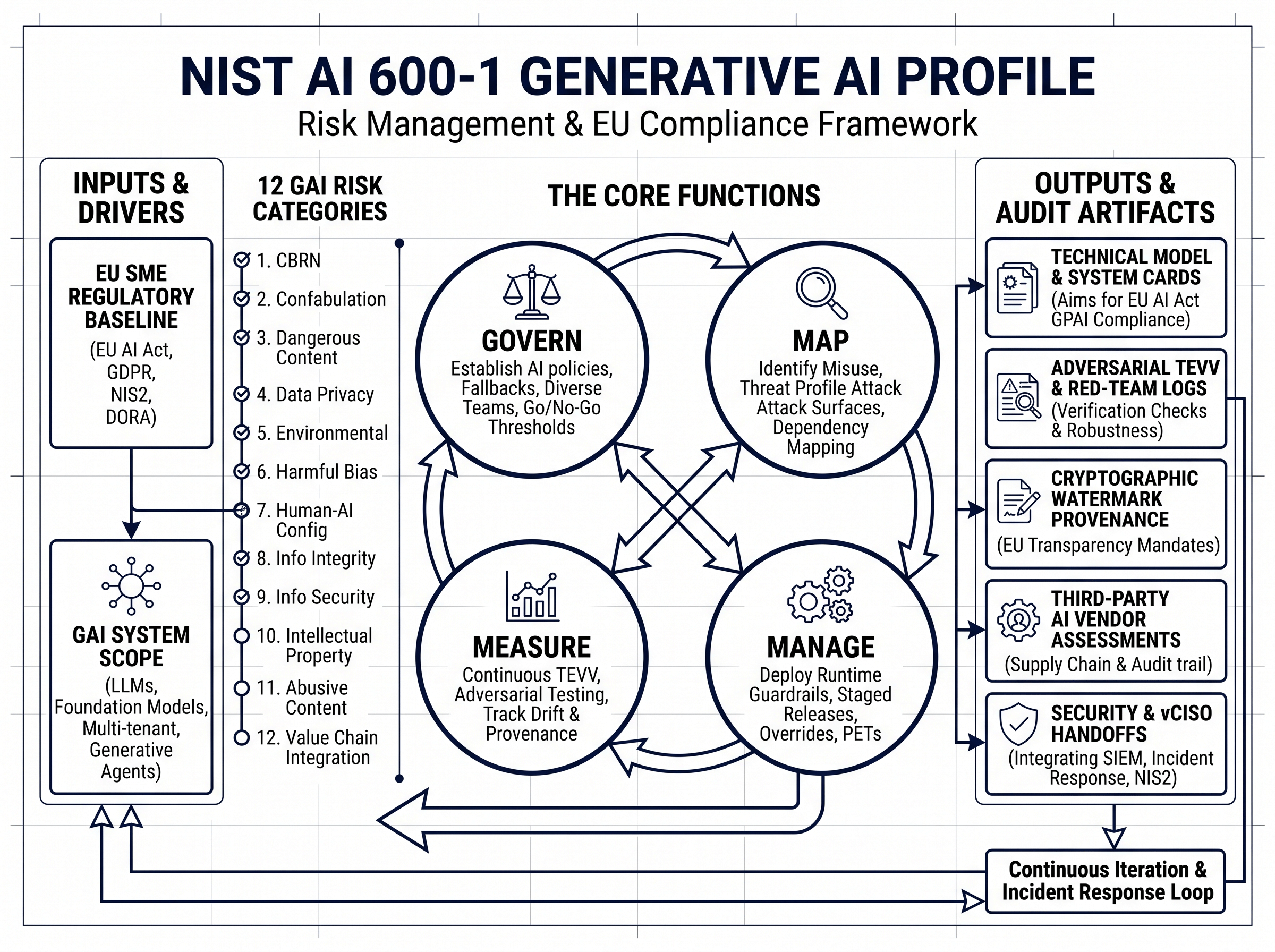
The 12 Generative AI Risk Categories
NIST AI 600-1 structures its guidance around 12 distinct risk categories amplified or uniquely generated by foundation models and GAI architectures:
| Risk Category | Definition and Operational Impact |
| 1. CBRN Capabilities | Lowered technical barriers to obtaining instructions or blueprints for chemical, biological, radiological, or nuclear weapons. |
| 2. Confabulation | Plausible but factually false, ungrounded, or nonsensical outputs (commonly termed hallucinations) presented with high epistemic confidence. |
| 3. Dangerous/Violent Content | System generation of material promoting self-harm, violent extremism, weapons manufacturing, or unlawful physical acts. |
| 4. Data Privacy | Unauthorized extraction, memorization, or disclosure of personally identifiable information (PII) via training data or RAG vector embeddings. |
| 5. Environmental Impacts | Systemic energy consumption and carbon emissions generated during intensive model pre-training, fine-tuning, and large-scale inference workloads. |
| 6. Harmful Bias & Homogenization | Amplification of societal prejudice, exclusionary cultural bias, and linguistic homogenization resulting from skewed training corpora. |
| 7. Human-AI Configuration | Socio-technical failure modes, including human over-reliance (automation bias), anthropomorphization, and emotional entanglement with conversational agents. |
| 8. Information Integrity | Scaled creation and automated dissemination of synthetic disinformation, deepfakes, and manipulated media eroding public trust. |
| 9. Information Security | Expanded threat surface for automated malware generation, social engineering, jailbreaking, and prompt injection vulnerabilities. |
| 10. Intellectual Property | Unlicensed replication of copyrighted assets, trademark infringement, and enterprise trade-secret leakage via prompt ingestion. |
| 11. Obscene/Abusive Content | Generation of non-consensual intimate imagery, synthetic child sexual abuse material (CSAM), or defamatory abuse. |
| 12. Value Chain Integration | Vulnerabilities inherited through third-party model weights, untrusted open-source libraries, compromised plugins, or opaque foundation model pipelines. |
Profile Architecture: The Four Core Functions Adapted for GAI
NIST AI 600-1 maps specific actions and control outcomes directly across the four foundational functions of the NIST AI RMF Core: GOVERN, MAP, MEASURE, and MANAGE.
| NIST AI 600-1 PROFILE CORE | |||
| GOVERN GAI Acceptable Use Policies (GV-6.1) Risk Tiers & Go/No-Go Thresholds (GV-1.3) Third-Party Fallback Plans (GV-6.2) Interdisciplinary Incident Teams (GV-2.1) | |||
| MAP | MEASURE | MANAGE | |
| Intended/Foreseeable Misuse Identification (MP-1.1) Context & Attack Surface Threat Profiling (MP-5.1) Supply Chain Dependency Mapping | Pre-Release Red-Teaming & Chaos Testing (MP-5.1) Benchmark Confabulation & Bias Metrics (MS-1.1) Model Cards & Architecture Documentation (MS-2.9) | Guardrail Controls & Overrides Data Provenance & Lineage (MG-2.2) Third-Party Drift Monitoring | |
| Production Feedback Loop (MANAGE → MAP) | |||
1. GOVERN
Establishes the enterprise accountability structures, operational mandates, and oversight policies necessary to manage generative models throughout their lifecycle:
- Suggested Action GV-1.2-002: Institute formal evaluation policies to continuously test risk-relevant GAI capabilities and safety controls before release and throughout deployment.
- Suggested Action GV-1.3-004: Define acceptable and unacceptable system use policies with input from affected stakeholder groups.
- Suggested Action GV-6.1-010: Update procurement and enterprise use policies to govern proprietary, third-party, and open-source generative technologies utilized by internal personnel and external contractors.
- Suggested Action GV-6.2-006: Document fallback protocols and business-continuity plans for third-party AI service outages, including graceful failovers to non-generative or manual workflows.
2. MAP
Focuses on identifying contextual boundaries, potential downstream harms, and technical interdependencies before development or integration begins:
- Suggested Action MP-1.1-004: Identify and document foreseeable illegal uses, malicious exploits, or high-risk applications that violate organizational tolerance thresholds.
- Suggested Action MP-5.1-006: Profile the cyberattack surfaces introduced by generative models, analyzing vulnerabilities resulting from model interaction, content generation, and third-party plugin invocation.
3. MEASURE
Applies rigorous qualitative and quantitative testing methodologies, benchmarks, and evaluation tools to assess system behavior:
- Suggested Action MP-5.1-005 / MS-2.7: Conduct pre-deployment adversarial red-teaming, prompt injection simulations, and automated chaos testing to reveal hidden failure modes.
- Suggested Action MS-1.1-005: Evaluate novel measurement tools to benchmark content provenance, confabulation rates, and toxic outputs while preserving model utility.
- Suggested Action MS-2.9-002: Compile formal system documentation detailing model architectures, training data provenance, optimisation targets, fine-tuning methodologies, and performance trade-offs.
4. MANAGE
Allocates resources to mitigate, transfer, or accept mapped and measured risks, maintaining operational guardrails in production environments:
- Suggested Action MG-1.3: Deploy staged releases, sandbox validations, and strict rate limits to manage risks that approach organizational tolerance thresholds.
- Suggested Action MG-2.2-007: Integrate runtime auditing mechanisms to track and validate the authenticity, digital lineage, and watermarking of generated synthetic outputs.
- Suggested Action MG-2.2-009: Incorporate synthetic data and privacy-enhancing technologies (PETs) to protect sensitive personal records during fine-tuning while preventing downstream homogenization.
Operationalising NIST AI 600-1 for EU Compliance
For EU enterprises, implementing NIST AI 600-1 provides direct technical scaffolding to satisfy statutory mandates across European legal frameworks:
Statutory / Threat Driver
- EU AI Act (Regulation (EU) 2024/1689): Active enforcement of Article 50 transparency obligations requires deployers to mark synthetic text, audio, and visual content in machine-readable formats and inform individuals when interacting with an AI system. In addition, providers of GPAI models must maintain technical documentation and evaluate systemic risks. Note that compliance deadlines for high-risk systems under Annex III have been set for December 2, 2027 (via Regulation (EU) 2026/1744), allowing organisations to focus immediately on GPAI risk baselines, systemic evaluation, and transparency documentation.
- GDPR / Privacy Engineering: Processing personal data via generative model fine-tuning or vector databases requires absolute adherence to Article 5 (Purpose Limitation and Data Minimization) and Article 22 (Human Oversight for Automated Decisions).
- NIS2 Directive & DORA: Cloud-based foundational model APIs represent critical third-party ICT dependencies, requiring documented resilience testing, counterparty evaluation, and supply chain concentration risk assessments.
- Eurostack Digital Sovereignty: Deploying sensitive enterprise workloads on sovereign European infrastructure or local open-weight models mitigates extraterritorial legal exposure under the US CLOUD Act and FISA 702.
Technical Control / Architecture
To satisfy both NIST AI 600-1 and EU mandates, organisations must deploy targeted technical controls:
- Retrieval-Augmented Generation (RAG) IAM Inheritance: Vector databases storing enterprise documents must enforce identity and access management (IAM) inheritance at query time, ensuring users retrieve only embeddings authorised under existing access privileges.
- Agentic Execution Guardrails: Autonomous agents interacting with external APIs must be restricted via deterministic tool-execution whitelists, cryptographic Agent IDs, strict action authorisation matrices, and automated runtime rate-limiting.
- Zero-Data-Retention (ZDR) Enclaves: Third-party model API contracts must enforce zero-retention policies on prompt logs and generated outputs, preventing proprietary or personal data from being used in upstream model training.
Audit Artifacts
To demonstrate defensibility before third-party auditors and regulatory authorities, organisations should generate and maintain:
- System and Model Cards: Detailed documentation tracking data lineage, training boundaries, known confabulation rates, and intended operational contexts (aligned to MS-2.9-002).
- Adversarial TEVV Reports: Independent red-team evaluation logs recording system resilience against prompt injection, jailbreaking, and data extraction attempts (aligned to MP-5.1-005).
- Third-Party AI Vendor Assessments: Auditable reviews of upstream model providers verifying SOC 2 Type II, ISO/IEC 42001 conformity, zero-data-retention compliance, and geographic data residency.
- Content Provenance Verification Records: Cryptographic watermark manifests and metadata logs confirming compliance with EU AI Act Article 50 synthetic disclosure mandates.