Statutory Driver: What the EU AI Act Is
Regulation (EU) 2024/1689 (the EU AI Act) is the European Union’s comprehensive horizontal legislative framework regulating the development, import, distribution, and deployment of artificial intelligence systems within the EU single market. Entering into force on 1 August 2024, the regulation applies extraterritorially to any entity whose AI system outputs are utilised within the European Economic Area (EEA), regardless of the provider’s physical location.
The Act establishes product-safety and fundamental-rights compliance requirements, operating under the New Legislative Framework (NLF) for CE-marking and market surveillance. For small and medium-sized enterprises (SMEs), it establishes legally binding obligations that vary based on the specific operational role (provider, deployer, importer, distributor) and the assigned risk tier of the AI workflow.
Operational Scope: What the EU AI Act Does
The EU AI Act governs software that generates outputs such as predictions, recommendations, content, or decisions influencing physical or virtual environments. For EU enterprises and stakeholders, the Act executes three operational functions:
- Risk-Based Market Access: It conditions lawful market access and enterprise use on documented risk management, technical documentation, and quality governance rather than applying uniform burdens across all software applications.
- Algorithmic Accountability: It mandates traceability across data pipelines, audit logging at runtime, human oversight mechanisms, and post-market monitoring to verify model safety and accuracy.
- Information Integrity and Transparency: It enforces disclosures for systems interacting with natural persons, detects or generates synthetic media, and establishes supply-chain transparency for foundation models.
Legislative Structure and Content Summary
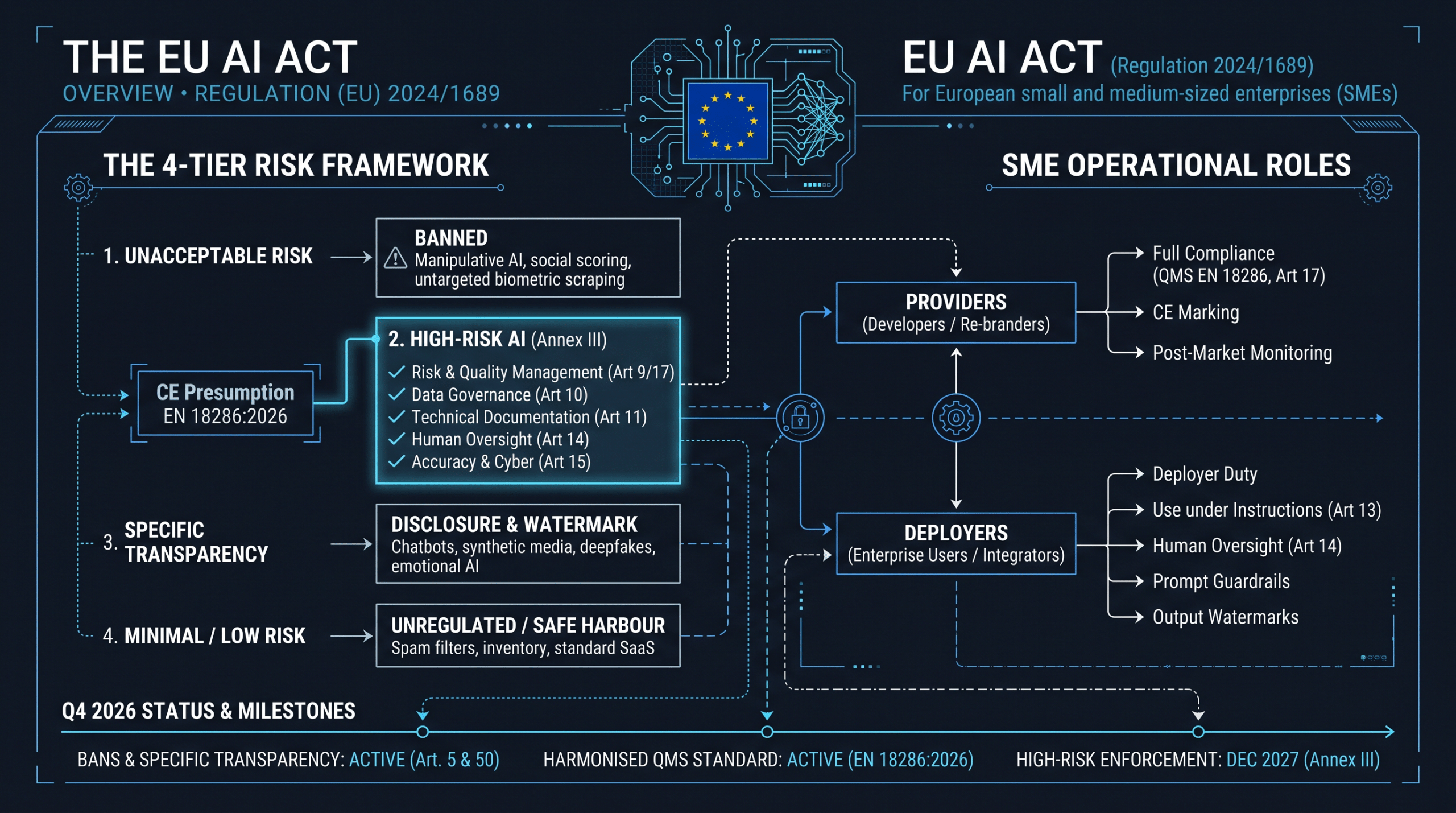
The Act organises regulatory requirements into four core risk tiers, supplemented by specific horizontal rules for General-Purpose AI (GPAI):
| Risk Tier | Description / Examples |
| 1. Unacceptable Risk (Prohibited Practices – Art. 5) | Cognitive manipulation, social scoring, biometric scraping |
| 2. High Risk (Annex III & Product Safety – Arts. 6-49) | HR/recruitment, critical infrastructure, credit, biometric |
| 3. Specific Transparency Risk (Art. 50) | Chatbots, synthetic media (deepfakes), biometric categorization |
| 4. Minimal / Low Risk | Spam filters, inventory optimization, basic business tools |
| Supplementary Horizontal Framework: Chapter V (Arts. 51-55) – General-Purpose AI (GPAI) Models & Systemic Risk Governance | |
1. Prohibited AI Practices (Chapter II, Article 5)
A narrow subset of AI uses is banned outright across the EU:
- Biometric categorisation evaluating protected attributes (race, political opinions, trade union membership, religious or philosophical beliefs, sexual orientation).
- Social scoring and evaluation of natural persons based on social behaviour leading to detrimental treatment.
- Real-time remote biometric identification in publicly accessible spaces for law enforcement (subject to narrow statutory exceptions).
- Subliminal, manipulative, or deceptive techniques that distort human behavior and impair informed decision-making causing significant harm.
- Untargeted scraping of facial images from the internet or CCTV footage to build facial recognition databases.
2. High-Risk AI Systems (Chapter III, Articles 6–49 & Annex III)
Systems designated as high-risk encompass products subject to third-party conformity assessments under existing EU product harmonisation rules (e.g., medical devices, machinery) and standalone use cases listed under Annex III:
- Employment and Worker Management: Automated recruitment tooling, CV filtering, candidate evaluation, task allocation, and workplace performance monitoring.
- Access to Essential Services: Credit scoring, risk assessment and pricing for health and life insurance, and access to public assistance benefits.
- Critical Infrastructure: Safety components in digital infrastructure, road traffic management, and utility networks.
- Education and Vocational Training: Systems determining access, admission, or evaluating student test performances.
- Law Enforcement, Migration, and Administration of Justice: Polygraph tools, risk assessment of individuals, and automated evidence evaluation.
High-risk AI systems require compliance with strict technical controls:
- Risk Management System (Article 9): Continuous, iterative identification and mitigation of technical failure modes and fundamental rights risks across the lifecycle.
- Data Governance (Article 10): Training, validation, and testing datasets must satisfy data quality criteria, bias mitigation, and representativeness standards.
- Technical Documentation & Record-Keeping (Articles 11 & 12): Annex IV technical dossiers and automatic generation of tamper-evident system logs during runtime.
- Transparency and Instructions for Use (Article 13): Clear operational manuals detailing performance bounds, error margins, and technical parameters.
- Human Oversight (Article 14): Technical mechanisms allowing human operators to monitor operations, override decisions, or activate emergency stops.
- Accuracy, Robustness, and Cybersecurity (Article 15): Resilience against adversarial attacks, prompt injections, data poisoning, and model evasion.
- Quality Management System (Article 17): Documented policies and operational procedures governing conformity and design control.
3. Transparency Obligations (Chapter IV, Article 50)
Systems that interact directly with individuals, generate synthetic content, or detect emotions face specific transparency mandates:
- Interaction Notification: AI systems directly conversing with users (such as customer service chatbots) must explicitly notify users that they are interacting with an AI, unless evident from context.
- Synthetic Content Watermarking: Audio, image, video, or text outputs generated or manipulated by AI must be marked in a machine-readable format and detectable as artificially generated.
- Deepfake Disclosure: Systems generating realistic synthetic media depicting real persons, events, or places must visibly disclose that the content is artificially manipulated.
4. General-Purpose AI (GPAI) Models (Chapter V, Articles 51–55)
Upstream foundation model providers must maintain technical documentation, furnish downstream system integrators with integration manuals, comply with EU copyright rules, and release public summaries of their training data. GPAI models trained with computational power exceeding 1025 FLOPs, or otherwise classified as presenting systemic risk, face mandatory adversarial model evaluation (red-teaming), systemic risk assessments, and cyber incident reporting.
5. Minimal and Low Risk
The majority of operational AI applications (e.g., standard classification algorithms, search indexing, inventory forecasting, spam filters) carry no mandatory compliance obligations under the Act, though adherence to voluntary codes of conduct is encouraged.
Technical Controls, Architecture, and Audit Artifacts for SMEs
For SME stakeholders, regulatory exposure concentrates in two roles: Deployers (businesses using third-party AI for internal workflows or customer-facing operations) and Providers (businesses developing proprietary AI models or branding third-party models under their own name).
|
Ingestion & Identity Layer |
Execution Enclave |
Output & Egress Gate |
|
Role-Based IAM Credentials• Context-Level Tenant Scoping |
Deterministic Schemas• Prompt Guardrails |
Machine-Readable Watermarking• Latency & Drift Telemetry Sink |
|
Central Audit SIEM |
1. Technical Controls and Architecture
- IAM and Vector Scoping for RAG: Deploy strict user-level access-control inheritance in retrieval-augmented generation pipelines to prevent models from extracting and surfacing unprivileged corporate data across tenants.
- Content Provenance Pipelines (Article 50): Integrate automated cryptographic watermarking or provenance metadata injection (such as C2PA standards) into all generative media pipelines prior to user delivery.
- Automated Audit Logging (Article 12): Route inference events, input-output pairs, error states, and latency metrics to write-once, append-only centralised log repositories with retention policies matching regulatory audit horizons.
- Human Oversight Interfaces (Article 14): Implement operational intervention layers—such as dual-authorisation review checkpoints for high-stakes decisions and orchestration-level kill switches—enabling human operators to halt execution.
2. Audit Artifacts
To demonstrate defensible compliance during regulatory inquiries or customer procurement audits, enterprises must assemble the following documentation dossier:
- AI Asset Inventory & Classification Register: An authoritative catalogue indexing all commercial models, open-source weights, and API dependencies, mapped against EU AI Act risk tiers and GDPR Article 22 applicability.
- Standard Operating Procedures for Human Oversight: Documented operational guidelines defining human reviewer roles, override authorisation matrices, and incident escalation protocols.
- Vendor Due Diligence Packs: Verification records showing that third-party model providers supply required technical data sheets, training disclosures, and zero-data-retention (ZDR) infrastructure commitments.
- Harmonised Standard Conformity Dossier (Article 40): For entities building or integrating high-risk workflows, an alignment matrix mapping internal controls to standard EN 18286:2026 to establish a legal presumption of conformity with Article 17 QMS mandates.
Team Demarcation and vCISO Handoff
Deploying compliant AI architectures requires clear operational separation between the AI Governance specialist and the enterprise security lead (vCISO / Cybersecurity team):
- AI Governance Lead Deliverables:
- AI risk categorization and technical documentation files under Articles 11 and 50.
- Design of post-market drift metrics, bias thresholds, and model evaluation protocols.
- Article 22 GDPR automated-decision impact assessments and prompt-chain data lineage policies.
- vCISO / Cybersecurity Team Handoff:
- SIEM ingestion of model telemetry, adversarial prompt-injection alerts, and anomalous egress spikes.
- Endpoint, perimeter, and network hardening around model inference clusters under NIS2 Article 21 baseline controls.
- Third-party ICT supply-chain resilience reviews and concentration risk assessments under NIS2 and DORA frameworks.
Current State of Play: Q4 2026
The regulatory framework is fully operational across primary milestones, with specific enforcement mechanisms active across the single market:
| Regulatory Provision | Statutory Target | Operational Status (Q4 2026) |
| Chapter II (Article 5) | Prohibited AI Practices | Fully enforceable. Banned practices are subject to active market surveillance and supervisory bans. |
| Chapter IV (Article 50) | Transparency & Watermarking | Enforced. Automated disclosures for synthetic media, chatbots, and generative content are mandatory. |
| Chapter V (Articles 51–55) | General-Purpose AI (GPAI) | Active enforcement. Providers of foundation models must adhere to transparency templates, copyright compliance, and GPAI Codes of Practice. |
| Implementing Decision (EU) 2026/2274 | Harmonised Standards Citation | Published October 2026. Standard EN 18286:2026 is formally cited in the Official Journal, activating legal presumption of conformity for Article 17 QMS obligations. |
| Annex III High-Risk Systems | High-Risk Use Case Obligations | The compliance enforcement date for Annex III high-risk use cases is set for December 2, 2027 (via Regulation (EU) 2026/1744). |
For EU SMEs, the immediate operational imperative in late 2026 is maintaining transparent user-facing generative systems, auditing supply-chain model dependencies against EU transparency standards, and establishing standard-aligned quality management procedures ahead of the high-risk enforcement deadlines.